
On this page you can find details on how to travel around Southwestern USA – when to go, what are the prices, etc. Technical details, but super important when you travel around!
When to go and for how long?
There are several moments of the year when you can go there. We chose December as it was the easiest for us to get long holiday at that moment. It’s also good moment to visit all 3 countries – temperature was optimal for sight-seeing and heat was fully bearable. However, weather is a little bit unpredictable at that time – we had a lot of cloudy sky (mostly without rain), but people who were doing exactly the same route few days later had sun all the time. Anyway, if I would go there again, I would chose the same period.
Please keep in mind that north and middle Vietnam will be rather cold at that time (you will need long trousers, light jacket and sometimes even fleece jacket), but in Cambodia, Bangkok and south Vietnam temperature will be above 20 degrees, so it will be possible to wear just shorts. But still – if you want to lie on the beach and enjoy sun, then go for different period. But be aware that in summer that region is extremely hot.
How to travel around?
Generally the best option is to start from Hanoi and then go south through whole Vietnam, visit Cambodia and end up in Bangkok. Then you will need to close the circle and come back to Hanoi. You can also do it the other way around, but I found super interesting to visit Hanoi as one of the first places during our trip. Bear in mind that the cheapest flights from Europe are usually to Bangkok. Due to this fact we modified a little bit the planning and we started from Bangkok, next day we flied to Hanoi and then we followed above mentioned itinerary with finish in Bangkok. This saved us quite a lot of money.
Once you reach Hanoi, the best way to move south is train. It’s possible to book it upfront, but you cannot do it directly from Vietnamese Railways website, but through travel agency – Baolau. You will have to pay additional fee, but the only other choice is to buy tickets once you are in Vietnam.
I think that using night train is something you should really experience, however be aware that the level of cleanness is not the same as in Europe. At least I have never heard in European trains my friends shouting from the lower bed “hey, the cockroach is going to you now”. Also the quality of rails is not good, what means that the whole train shakes like crazy. For me it worked like a cradle, but Lukasz was not able to sleep at all during that 10 hours journey. And last remark – don’t try to book hard seats or 6 persons space for sleeping. Invest a little bit more money to get 4 persons carriage as it is much more comfortable.
If you don’t want to experience night train or the distance is too long, then the other option is plane. Flights in Asia are very cheap and most of the bigger city are quite nicely connected. We took flights between Bangkok – Hanoi, Da Nang – Saigon (Ho Chi Minh City), Saigon – Siem Reap and Siem Reap – Bangkok. Especially Da Nang – Saigon flight was a good deal in comparison to very long train ride on this route. Each airline was nice, except of the Cambodian Airlines, which are quite known from flights being cancelled or delayed. Unfortunately, it also harmed us, so if I can advise something – take additional slack of time in Siem Reap to accommodate potential delays in travel.
Other popular way of transportation in Vietnam and Cambodia is bus. We never took any of long distance bus and I would rather discourage you to do so. According to many online forums and opinions of my friends, they are not so comfortable and much more dangerous. After experiencing crazy Vietnamese traffic I can imagine that it is not the safest way of travelling in that country. And bearing in mind prices of flights and / or trains, I think you should go for bus only as a last resort option.
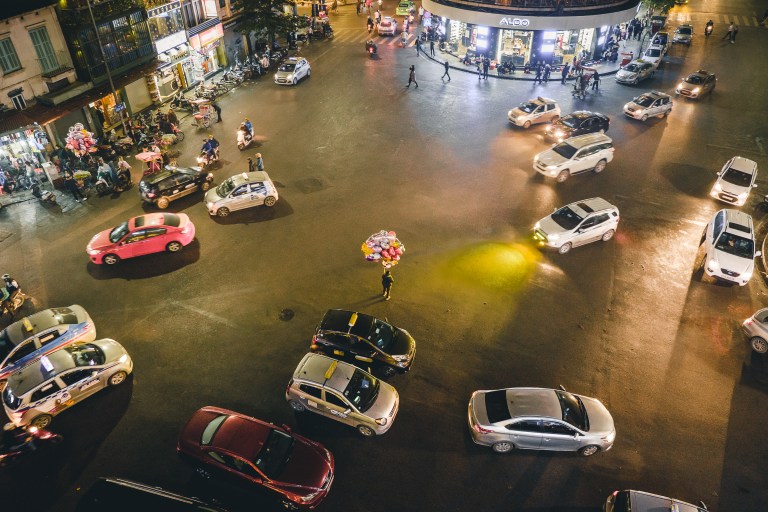
Regarding transportation within the cities, for us Uber was almost always the best option. Asian cities are big, public transport is quite scarce and Uber is really cheap in comparison to Europe. Average trip from one side of the city to the other was about 4-5 EUR. At the same time, walking around the cities is not really fun after first few days. Crazy traffic, polluted air, people riding even on the pavement makes it not so pleasant experience. You can also try to rent scouter or get Uber Moto, but you have to be quite courages to do so – traffic is really really crazy and it is nothing you can even imagine being in Europe. Just look at the below photo of the square in Hanoi – you can see that cars are going into every direction without any organisation of the traffic (and in the middle of the square there is person with balloons!).
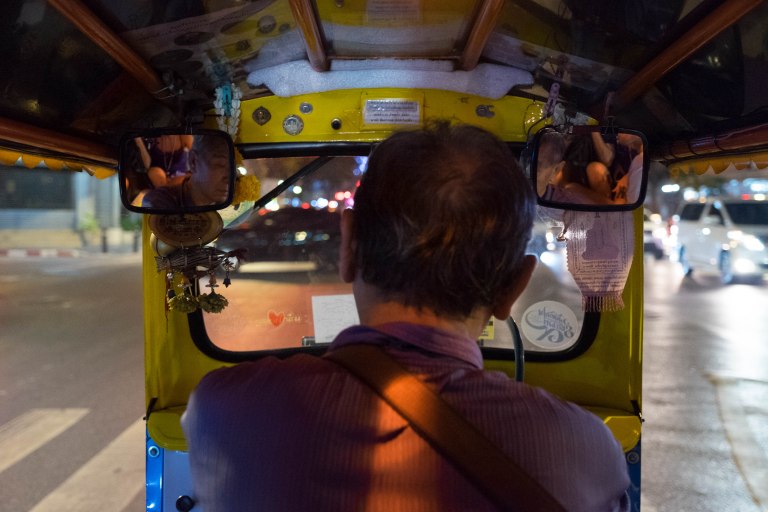
You can also use local competition of Uber, which is called Grab, but keep in mind that in case of this app, you will have to pay driver in cash at the end of the trip. As a last remark – once you are in Siem Reap there is no need to use Uber. Most of hotels have their own Tuk Tuks (it’s something like fusion of horse carriage and motorcycle) and once in the city center, you can also find cheap Tuk Tuks back.
What are the prices and currencies?
Prices highly depends on the country and even on the part of the country, so it’s really hard to give any reliable information. Generally prices are much lower than in Europe, unless you go to some really posh places.
Important thing is the currency. In Thailand and Vietnam you should use local currencies (respectively Bath and Dong), but in Cambodia the only currency that will be accepted from you is US dollar. I have heard about one girl who was quarrelling in each place to get bill in local currency in order to pay less. I can’t confirm this story for 100%, so I think it’s up to you to decide if you want to try this approach. Please be aware that not all dollars are accepted! Only banknotes that are not teared, stained and not too old will give you possibility to pay. Be really careful when you get change – usually seller will try to get rid of bad banknotes by giving it you. If you will take it, then you will not be able to pay with it in any other place. Some places accept such “bad” banknotes only if they will apply “haircut” – for example your 50$ banknote will be treated as 45$ or even less. In case of emergency you can always withdraw money from ATM – they also allow you to withdraw US dollars, however, you will pay quite a fee (around 5$ for 50$ withdrawal). You can’t as well pay with card in most of the places, so it is really good idea to take care of this already in your home country and take dollars in proper banknotes with you (and add quite a slack there as the cost of getting additional dollars once you run out of them in Cambodia is quite high).
In Vietnam, but also to some extent in Thailand, you can’t pay everywhere with card. Therefore the best approach is to withdraw money from ATM and use it further for purchases. It’s hard to say which ATM is the best as it is highly depended on your bank, but in Vietnam for us the best was SeaABank. Try not to use your main card or credit card as it may sometimes happen that your card will be skimmed and money from it stolen. It happened to us, but fortunately most of the time your bank will cover stolen amount. For me personally the best option is Revolut card, which I absolutely love for travelling.
What to bring with you?
Below there is a list of the most important things to take with you. It’s based on our experience and reluctance to take too much stuff with us – I usually take only as little things as possible.
- Good travelling backpack + small backpack – me and Lukasz always use Osprey. You will need backpack as in some places due to crazy traffic and pavement quality suitcase may not be the best option. Small backpack is good addition if you want to go to city or you have short 1 day trips. I usually use my big backpack with detachable small backpack.
- Rain-proof jacket – you can use also plastic poncho, but jacket you can also use as a layer to keep warmness.
- Fleece sweater or jacket – because it can get quite cold (north part of Vietnam).
- Shorts – because it can get really warm (Bangkok).
- Hand sanitiser – in many places you will need to wash your hands, but you will not have such option. Hand sanitiser will work perfectly in such cases.
- Insect repellent – in some places there are a lot of mosquitos (for example in Cambodia), so proper anti-insect product will be a saviour Especially regarding fact that some of the areas in southeast Asia have danger of getting malaria. Don’t be afraid of it as it’s still very low chance to get it, but just buy proper repellent. At least 40% of DETT.
- Malaria pills and proper vaccination – as I said, the bad news is that you can get malaria in southeast Asia. The good news is that there is very very very low chance you will get it. But still, visit your travel doctor and make sure that you have malaria pills with you and that all other vaccinations you have in place. You don’t have to take pills for prevention, currently it’s advised to take it once you start getting ill.
- SIM card – you can’t really take it with you from Europe, but it’s good to buy it directly after landing. Having access to Uber is really helpful and I would take one SIM at least in Vietnam.
Important – don’t take too much clothes with you. Many hotels give option to make a laundry and it is relatively cheap service (we were charged based on kilograms). Consequently, it is much better to pack light and book one of the hotels on the way for 2 days and make laundry there. I heard also about people who took almost empty backpack, bought all clothes in Asia and took them back home. To be honest I’m not really sure if that is the best idea – in Vietnam most of the clothes seemed like fake and in Thailand most of clothes were quite expensive (at least branded ones). I guess it makes sense only if you are going to buy the cheapest ones.
What to take for photography?
While packing I was imagining many situations when certain photo equipment will be useful, so I ended up with way too much gear. I took two bodies, 3 lenses and several other accessories. However, it turned out once again that during travelling less is more. I almost completely used my beloved x-t1 with just one lens – 16-55mm f/2.8 for the whole journey. And to be honest I didn’t miss any other lens even for a moment. During such trip you need something versatile – in Asian cities everything happens rapidly and you will not manage to capture such things without zoom. Except of this, you still want to take landscapes, portraits and you will not have time and conditions to change focal length by walking or by changing lens. So universal zoom sounds like the best idea. And bearing in mind that it’s good to travel light, it seems you should try to take mirrorless camera with that one universal zoom.
It’s also very useful to have weatherproof camera – it can be very humid or even rainy and you want to take pictures regardless of these conditions. Also places like Vietnamese jungle demand having durable gear. I fell down in there and I still think it’s kind of miracle that my camera survived. Weatherproofness and durability are keys for survival in such environment.
What to see and where to sleep?
In this region there is a lot to see and experience. Jungle, big cities, rural life, ancient temple and many many others. You should really try to experience as much different things as possible. Don’t limit yourself to one type of activity or only one type of touristic sights. If you want details, they are in the below itinerary.
Regarding sleeping – as always we slept almost everyday in different city. Hotels are really cheap in most of the places (except of Saigon and Bangkok). You can try to find super cheap option, but don’t forget that quality of hotels is still much lower than in Europe or America and often they look much better on the booking websites than in the reality. Therefore, it’s better to book hotel which seems to be a little bit higher standard than your usual choice, so after arriving you will find something you still enjoy (and the price will be lower than European one anyway).
I think the best hotel we had during this trip was in Hoi An. It’s a very good idea to stay for few days in this city to rest and enjoy the place. Good hotel will help you enjoying this time even more and there is quite many options there with good quality. I think it’s because this is very touristic city with people staying there to enjoy beaches and sun (not so possible in December unfortunately).
Please also be careful with the hotel in Siem Reap. This city is fully devoted to one source of income: tourists coming to see Angkor Wat complex. Therefore, you can see these huge hotels in the suburbs where travel agencies reserve hundreds of places. They are quite expensive and there is no need to be there if you have a choice. Other hotels are ok as well, but don’t expect super conditions even if they look on website booking as high standard.
What about Visas?
All the below points are based on the information for Polish citizens, but I think most of the European Union member countries will be treated the same way. But to be sure you have to verify information on the relevant websites of the countries.
- Cambodia – visa on arrival, 30$ in not destroyed or stained banknotes, don’t forget to take a photo with you. Size of the photo was not really a problem.
- Vietnam – you should apply for visa earlier. It costs 25$, but don’t forget about the photo. If you will not have one they will take a photo for you – it will cost 5$ more. It’s important to have visa approval letter printed with you during the trip – we were asked to present it on departure from Bangkok, otherwise we would not be able to enter the plane.
- Thailand – just VISA on arrival, no photo needed, but have somewhere address of your hotel as you will need to fill in the arrival card. Don’t worry if you will loose departure card that you will get upon arrival – in such case you will get new form when leaving the country.
What to bring as a souvenir?
I think that everyone knows not to bring anything that was given to you or if you were requested to bring something back to Europe. We all know these bad stories about people smuggling narcotics without even knowing that, so please try to avoid such situations. But what to bring with you then? Few ideas from my side (even tough I only brought some magnets):
- Vietnamese coffee – once you will try it you will understand why you should bring it back
- Straw hat – typical souvenir from Vietnam
- Buddha statue – I rather discourage you from buying this – all over the touristic spots in Bangkok you can see posters that explain that using buddha statute for decoration is disrespectful for buddhism.
 Ultimate Traveler